
You know the scene. It’s Friday night. The pizza boxes are empty, leaving only grease stains and a few lonely crusts. The energy drink cans are crushed. And across the table, your friend Dave is staring at the game board with the intensity of a bomb disposal expert deciding which wire to cut.
He’s holding a single meeple. He hovers it over one hex. Then another. Then he pulls back. He picks up the rulebook. He puts it down. He sighs.
Welcome to the phantom zone of tabletop gaming: Analysis Paralysis (AP). It’s that moment when the game grinds to a halt because someone is trying to calculate the mathematical probability of every possible future outcome, effectively aging the rest of the group by about five years.
If you play board games or tabletop RPGs long enough, you know that waiting isn’t just a pause in the action—it’s a lifestyle. Here’s a look at the culture of the „long turn” and how we survive it without flipping the table.
The „Let Me Just Read This Spell Again” Phenomenon
In the realm of tabletop RPGs, the wait hits different. We aren’t just moving pieces; we’re weaving a narrative. Or at least, we’re trying to. But momentum is a fragile thing.
There’s a specific kind of pain reserved for when the Wizard’s turn comes up. They’ve had twenty minutes—literally the entire combat round—to decide what to do. The Barbarian smashed, the Rogue hid, the Cleric healed. Now, the spotlight is on the spellcaster.
„Okay,” they say, flipping through pages. „I think I want to cast Fireball. Wait. Does this creature have resistance to fire? Let me check my other spells. Actually, what’s the range on Magic Missile again?”
Real talk: The silence that follows is loud. You can hear the Dungeon Master’s patience evaporating. You can hear the dice settling into the resin. This is where the mind starts to wander. You start stacking your dice into little towers. You check your phone, even though you know you shouldn’t. You start contemplating if your character would actually just lay down and take a nap in the middle of the dungeon.
The Five Stages of Waiting for Your Turn
Much like grief, waiting for a slow player involves a distinct emotional journey. If you’ve ever played a heavy euro-game or a complex 4X strategy game, you’ve lived this cycle.
1. Denial
„They’re just thinking. It’s a complex turn. I appreciate a good strategy. I’ll use this time to plan my next three moves. This is fine.”
2. Boredom
You’ve planned your moves. You’ve planned your backup moves. You’ve reorganized your resource tokens by color and size. You’ve read the flavor text on every card in your hand. Twice.
3. Hunger
Suddenly, the empty snack bowl looks like a personal affront. You debate making a kitchen run, but the fear of missing the exact moment the turn ends keeps you glued to the chair.
4. The „Look”
This is the stage where players start making eye contact with each other. No words are exchanged. Just a subtle raise of the eyebrows. A slight tilt of the head toward the perpetrator. It’s a silent telepathic conversation that screams, „Are we still doing this?”
5. Acceptance (and Cobwebs)
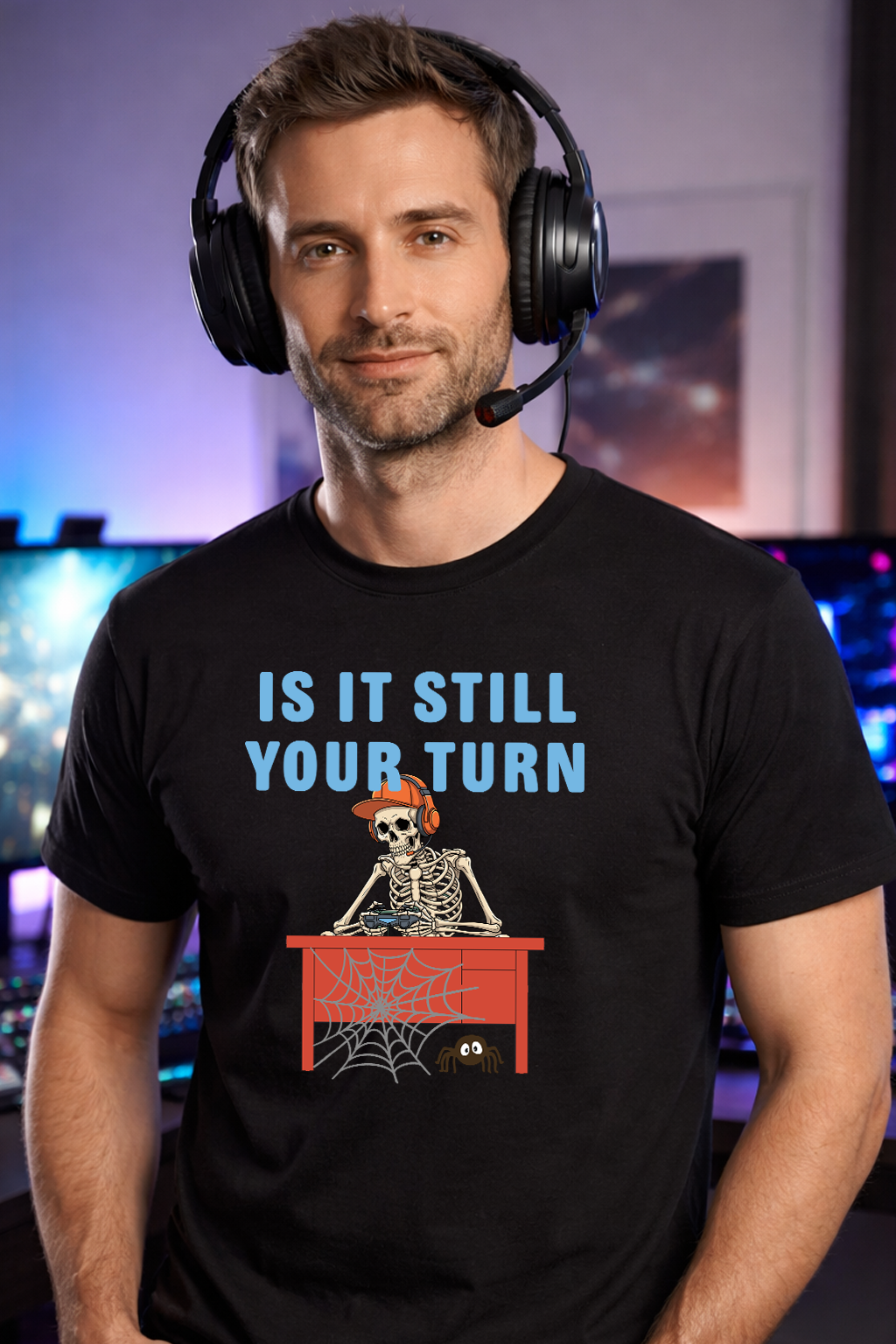
You have become one with the chair. You are the skeleton meme. You realize that your turn might not come for another season. You find peace in the void.
Why Do We Do This to Each Other?
Here’s the thing: Analysis Paralysis usually comes from a good place. It comes from wanting to play well. Nobody wants to be the person who makes a blunder that costs the team the game (in co-op) or hands victory to an opponent (in competitive).
The „Min-Maxer” isn’t trying to annoy you; they are trying to solve a puzzle. The „Indecisive Roleplayer” isn’t stalling; they are worried about character consistency. But the impact on the table is real.
Tabletop gaming is a social contract. We agree to a shared hallucination of rules and themes. But there’s an unwritten clause in that contract: Keep it moving. A imperfect turn played quickly is often better for the group’s morale than a perfect turn played after a ten-minute delay.
How to Nudge the Turtle (Without Being a Jerk)
So, how do you handle the chronic over-thinker without ruining the vibes? You can’t just yell „Hurry up!” unless you’re really close friends (and even then, it’s risky).
The Timer: Introducing a sand timer is the classic move. It adds tension. It forces gut decisions. It also stresses some people out to the point of melting down, so use with caution.
The „On Deck” Call: In larger groups, having the GM or a designated player announce who is „on deck” (up next) can snap people out of their daydream. „Sarah, you’re up. Mike, you’re on deck.”
The Visual Hint: Sometimes, you need to be passive-aggressive in a funny way. This is where gaming culture shines. We turn our frustrations into jokes. We make memes about skeletons waiting at tables. We wear our impatience on our sleeves—literally.
There’s something cathartic about acknowledging the absurdity of the situation. When everyone laughs about how long the turn is taking, the tension breaks. It turns a frustrating delay into a shared joke.
It’s Still Better Than Not Playing
At the end of the day, despite the waiting, the cold pizza, and the mental fatigue, we keep coming back to the table. Why?
Because in a world of digital disconnect, sitting around a table with friends is special. Even if ten percent of that time is spent watching Dave stare at a cardboard map.
We wait because the payoff—the critical hit, the last-minute victory, the collaborative storytelling—is worth it. We tolerate the Analysis Paralysis because we love the players. But that doesn’t mean we can’t poke a little fun at them while we wait.
So next time you find yourself stacking dice for the hundredth time, take a deep breath. Look at your friends. And maybe, just maybe, gently ask: „Is it still your turn?”
Where to Find This Design
If you relate to the skeleton waiting at the table (or know someone who causes that wait), check out the collection. View on Redbubble or Check on TeePublic.